It's day three. Your nipples are sore, your baby keeps slipping off the breast, and a chart somewhere says newborns "feed every two to three hours" — which feels like a cruel joke when yours wants to nurse every forty minutes. Here's the truth nobody tells you at the hospital: breastfeeding is a learned skill, for both of you, and the first two weeks are the hardest part. Almost everything that feels broken right now is fixable, and a lot of it is simply normal.
This is a no-pressure starter guide to the latch — what a good one looks like, how often to expect to feed, and how to know your baby is actually getting enough. And because feeding is feeding: if breastfeeding isn't working for your family, you have not failed at anything. A fed baby and a supported parent is the entire goal.
What the science says about the latch
A "latch" is just how your baby's mouth connects to your breast — and a deep latch is the single biggest predictor of comfortable, effective feeding. The key idea is areola, not nipple: your baby should take a big mouthful of breast, not just the tip. When the nipple sits far back near the soft palate, it doesn't get compressed and pinched, milk flows well, and your breast gets the signal to make more.
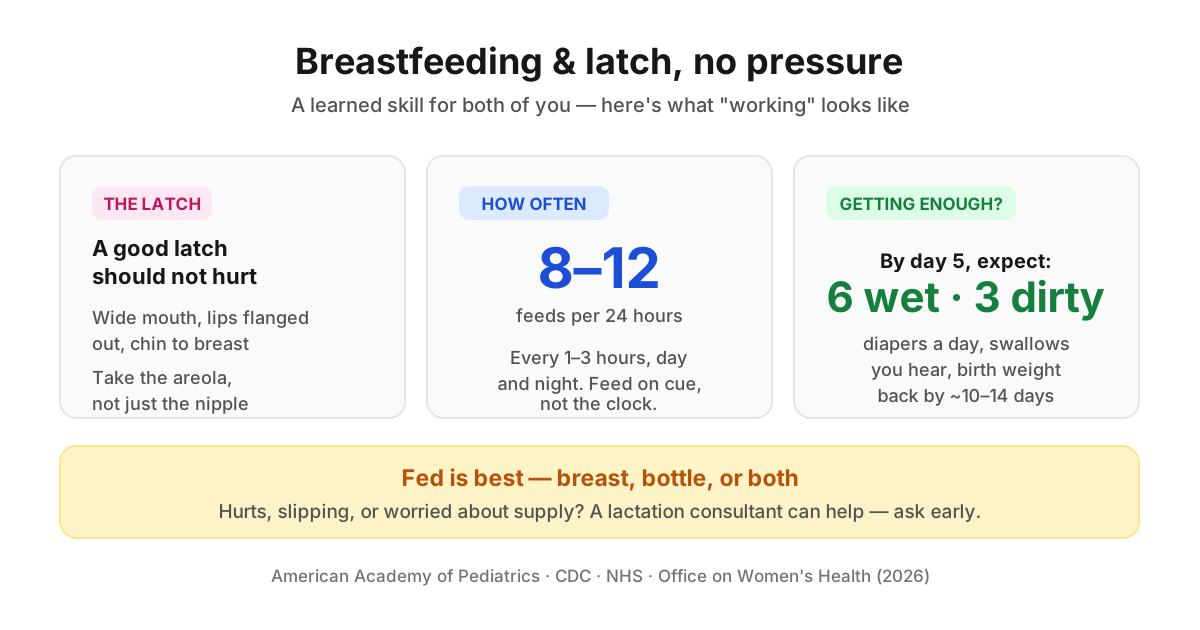
The Office on Women's Health describes a good latch this way: it feels comfortable and doesn't hurt or pinch, baby's lips flange outward "like fish lips, not inward," the chin touches your breast, and you can see or hear swallowing. The NHS adds two more tells: more of the dark areola shows above baby's top lip than below the bottom lip, and baby's cheeks look full and rounded (not dimpled or sucked-in) during feeding.
The most important signal of all is the simplest: a correct latch should not hurt. A few seconds of tugging or tenderness in the first week is common. Pinching pain, a creased or lipstick-shaped nipple after feeds, or cracking is your baby telling you they're on the nipple alone. That's a latch to fix, not pain to push through.
How to get a deep latch
You don't need a complicated hold. The NHS and OWH both teach the same core sequence — go slow and let baby do more of the work than you'd expect:
- Get comfortable and close. Bring baby to your breast (chest-to-chest), not your breast to baby. Their whole body faces you, ear-shoulder-hip in a line, so their head isn't twisted.
- Nose to nipple. Line baby's nose up with your nipple, not their mouth. This makes them tip their head back and come up and over for a deep mouthful.
- Wait for the wide gape. Brush your nipple on their top lip and wait for a wide-open mouth, like a yawn. Patience here is everything — a half-open mouth gets a shallow latch.
- Chin first, then on. When the mouth is wide, bring baby on quickly so the chin touches the breast first and the nipple aims toward the roof of their mouth.
- Check and reset if needed. Lips flanged out, more areola showing on top, no pinching. If it's not right, break the suction by slipping a clean finger into the corner of baby's mouth — never pull off — and try again. Relatching ten times in one feed is normal in week one.
If watching beats reading at 3 a.m., this short clip from the Global Health Media Project demonstrates attaching baby at the breast step by step:
How often newborns actually feed
Brace yourself: a lot. Newborns nurse about 8 to 12 times in every 24 hours, according to the AAP and CDC — roughly every 1 to 3 hours, around the clock, counting overnight. That frequency isn't a sign of low supply; it's how a tiny stomach and a milk-supply feedback loop are designed to work.
A few rules that make this easier:
- Feed on cue, not the clock. The AAP lists early hunger cues as rooting, lip-smacking, suckling motions, and bringing hands to the mouth. Crying is a late sign of hunger — a hangry baby is harder to latch, so try to catch them earlier.
- Don't time or ration feeds. Let baby finish the first breast and come off on their own before offering the second; the milk gets fattier as a feed goes on. The AAP advises a newborn shouldn't go longer than about 2–3 hours during the day or 4 hours at night without feeding in the early weeks.
- Cluster feeding is real. Some evenings your baby will want to nurse almost continuously for a few hours. It's normal, it's often tied to growth spurts, and it is not a verdict on your supply.
Tracking those first chaotic days — feeds, sides, diapers — helps you (and your pediatrician) see the rhythm instead of guessing. You can log feeds in seconds in the TinyWins journal and watch the pattern emerge over a week. For the sleep side of the newborn chaos, our newborn sleep survival guide covers what's normal between feeds.
Is my baby getting enough? Follow the diapers
You can't measure ounces at the breast, so the body keeps score for you — in diapers and weight. What goes in comes out, so output is the most reliable everyday gauge.
Per the CDC's newborn breastfeeding basics, wet and dirty diapers ramp up over the first week as your milk comes in:
- Day 1: about 1 wet, 1 dirty
- Day 2: about 2 wet, 3 dirty
- Day 3: about 5 wet, 3 dirty
- Day 4: about 6 wet, 3 dirty
- Day 5–7 and beyond: at least 6 wet and 3 dirty diapers a day
Alongside diapers, the green-light signs are: you see or hear swallowing during feeds, baby seems content and drowsy after nursing, and the scale climbs. A little weight loss in the first days is expected; most babies are back to birth weight by about 10 to 14 days. Your pediatrician will weigh baby at the first visits precisely because the scale is the definitive answer to "is it working?"
When to call your pediatrician or a lactation consultant
Most early bumps smooth out with a better latch and a few days. But reach out promptly — these are the ones worth a same-day call. Per the CDC, call your pediatrician right away if your baby:
- Has fewer than 6 wet or 3 dirty diapers by day 5
- Keeps losing weight after day 5, or hasn't regained birth weight by about 2 weeks
- Is too sleepy to feed, is feeding fewer than 8 times a day, or you can't see or hear any swallowing
- Has trouble staying latched, or you hear clicking sounds (often a sign of a shallow latch)
- Looks increasingly yellow (jaundiced) in the skin or eyes
And see a lactation consultant (IBCLC) for anything that hurts or isn't clicking — cracked nipples, pain through whole feeds, a latch that keeps slipping, or worries about supply. This is exactly what they do, it's not a sign you're failing, and most parents who get hands-on help wish they'd asked sooner. The Office on Women's Health helpline (1-800-994-9662) can point you to local support.
Fed is best — and that's the whole point
Breastfeeding has genuine, well-documented benefits, which is why the AAP and CDC recommend it exclusively for about the first 6 months and alongside foods beyond that. But recommendations describe a goal, not a grade. Combination feeding, exclusive pumping, and formula all raise thriving babies — and your mental health, recovery, and bond are part of your baby's nutrition too.
If breastfeeding is going well, wonderful — feed on cue, watch the diapers, and trust the process. If it isn't, you have options and you have help, and choosing what works for your family is good parenting, not a compromise. When you're ready, our companion guide to formula feeding without guilt walks through doing it well.
You're learning a brand-new skill while sleep-deprived, on day three, with a tiny boss who doesn't read instructions. That you're here reading this means you're already doing the work.
This article is educational and not medical advice. Always check with your pediatrician/provider.