It is 4 p.m., and the baby who slept like a tiny angel all morning is now grunting, going purple, pulling up their legs, and crying in a way that makes you want to call someone — anyone — with an MD. Is it gas? Constipation? Something worse? You scroll three different websites and come away with five different answers and one rising sense of panic.
Here is the reassuring part, up front: the three most common "my baby is uncomfortable" worries — constipation, gas, and colic — are almost always normal, almost never dangerous, and almost entirely temporary. The trick is knowing which one you are actually looking at, what genuinely helps each, and the short list of signs that mean it is time to call. Let's triage.
First, the most common trap: that's just a newborn pooping
Before we talk about constipation, we have to talk about what isn't constipation, because this is where most of the worry comes from.
Newborns grunt, strain, turn red, and look deeply put-upon every time they have a bowel movement. According to the American Academy of Pediatrics, this is developmentally normal: babies are working against gravity while lying flat, with abdominal muscles that haven't figured out the job yet. The performance can be alarming. The result — a soft stool — is the proof that everything is fine.
So the number that matters is texture, not frequency, and not theatrics.
- A formula-fed baby usually goes most days, but a gap of a day or two is normal.
- A breastfed baby can go several days — sometimes a full week — between bowel movements once they're past the newborn weeks, and still be completely fine, as long as the stool that eventually arrives is soft.
A baby who strains, grunts, and then produces a soft poop is not constipated. They are just new at this.
Constipation: when it's real, and what actually helps
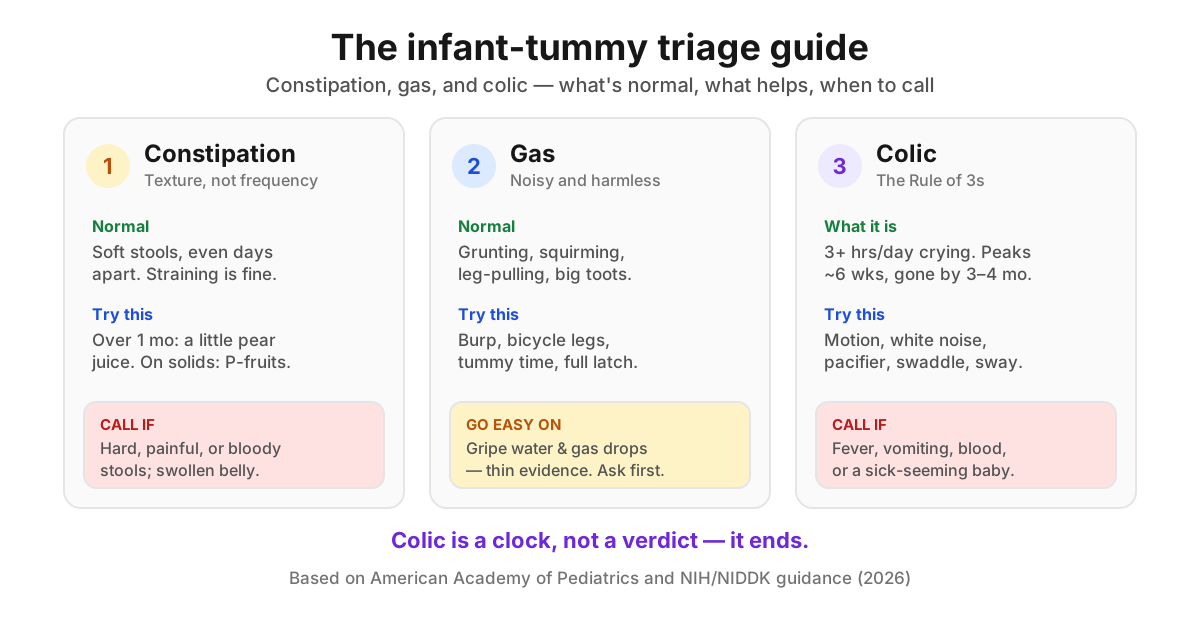
True constipation is about hard, dry, pebble-like stools that are painful to pass — not about how often. The AAP and NIH's NIDDK describe constipation as hard, dry, or lumpy stools that are difficult or painful to pass, sometimes with a child straining unsuccessfully for more than 10 minutes.
For a baby over 1 month old, the AAP's evidence-based first move is a small amount of 100% fruit juice — apple or pear — because the sugars they can't fully digest pull water into the intestine and soften the stool. The dose they suggest is roughly 1 ounce per month of age, up to a maximum of 4 ounces. (One note that trips people up: plain fruit juice is otherwise not recommended as a drink for babies under a year — this is a targeted, short-term constipation remedy, not a new beverage.)
Once your baby is eating solids, fiber does the heavy lifting. Think of the "P fruits" — prunes, pears, peaches, plums — plus other vegetables and fruits, and a little water offered with meals. NIDDK's advice is to add fiber gradually so the gut can adjust. Starting solids is, in fact, a common moment for stools to change and firm up — if you're in that phase, our guide to starting solids covers what's normal as your baby's diet shifts.
What to skip: laxatives, suppositories, enemas, mineral oil, or corn syrup — none of these belong in a baby without your pediatrician's say-so. If the hard stools don't budge with diet, that's the call to make.
Gas: noisy, dramatic, and almost always harmless
Every baby is gassy. They have immature digestive systems, they swallow air when they feed and when they cry, and they spend a lot of time horizontal. The grunting, the squirming, the leg-pulling, the impressively adult-sounding toots — it's all part of the package, and it rarely signals a problem.
The moves that genuinely help are simple and free:
- Burp partway through a feed and again at the end, rather than waiting until the very end.
- Bicycle the legs gently and do a few slow tummy-presses (knees toward belly) while baby is calm.
- Tummy time while awake and supervised gives gas an easier path out.
- Keep the air out: with bottles, keep the nipple full of milk; with breastfeeding, work on a deep latch so baby isn't gulping. Our breastfeeding latch basics guide can help if feeds feel air-y.
A quick word on remedies: gripe water and simethicone ("gas drops") are wildly popular and thinly supported. Studies haven't shown them to reliably outperform a placebo, and some gripe waters contain herbal ingredients or alcohol you'd rather not give a newborn. They're not generally dangerous, but they're not magic either — run any product past your pediatrician first, and don't feel you're failing your baby by skipping them.
If your baby is gassy and spitting up a lot, you may be looking at normal reflux rather than a tummy problem — our post on reflux and spit-up sorts the "happy spitter" from the rare baby who needs a closer look.
Colic: the clock that ends
Now for the hard one — the crying that isn't gas, isn't hunger, isn't a dirty diaper, and isn't anything you can fix.
Colic is the term for intense, inconsolable crying in a baby who is otherwise healthy, growing, and well-fed. The classic shorthand is the Rule of 3s: crying more than 3 hours a day, more than 3 days a week, for more than 3 weeks. The AAP notes it affects roughly one in five babies, typically begins around 2 to 4 weeks, and the daily fussing peaks near 6 weeks — about 3 hours a day at its worst — then winds down to an hour or two and is usually gone by 3 to 4 months (occasionally lingering toward 6 months).
The single most important thing to understand about colic: it is a diagnosis of exclusion. That means colic isn't a thing you can confirm at home — your pediatrician should first rule out anything treatable (an infection, reflux, a feeding problem, a cow's-milk-protein sensitivity). Once nothing else is found, the diagnosis is essentially "a healthy baby who cries a lot, for reasons we don't fully understand, and who will grow out of it."
While you ride it out, the AAP's relief toolkit is the soothing repertoire you already half-know:
- Motion — rocking, a baby carrier, a stroller walk, a car ride.
- Sound — white noise, a shushing sound, a quiet vacuum or fan, rhythmic music.
- Sucking — offer a pacifier.
- Swaddling for younger babies (retire it the moment they show signs of rolling).
- Positioning — holding baby tummy-down along your forearm with gentle back rubs, or a slow baby massage.
- If you're breastfeeding, some parents find a short trial off dairy, caffeine, or other suspects helps; for formula-fed babies, a pediatrician may suggest a hydrolysate formula. Try these with your doctor, not on a hunch.
Not every baby will be soothed by any of it on a given evening — and that is not a failure of your parenting. Some colicky crying simply has to run its course. Tracking the patterns (when the crying starts, what you tried, what the day's feeds and sleep looked like) can help you spot what helps and give your pediatrician a clear picture; logging it in the TinyWins app turns a blur of bad evenings into something you can actually see ending.
When to call — and the line we don't joke about
Most tummy trouble is laundry and lost sleep, not danger. But a few signs mean stop triaging and pick up the phone.
Call your pediatrician if your fussy or constipated baby also has:
- A fever — and remember, in a baby under 3 months, 100.4°F (38°C) or higher is always an emergency, no exceptions. See newborn fever: when to worry.
- Blood in the stool, or hard stools that are causing pain or tiny tears.
- Vomiting (especially forceful or green), a swollen, hard, or tender belly, or refusal to feed.
- A sudden, dramatic change — far more or far fewer stools than usual, or a baby who suddenly seems sick rather than just upset.
- Crying that changes character — a high-pitched, weak, or completely different cry, or a baby who is hard to rouse.
And one more, the one we say plainly because it matters most: colic is brutal on parents. Hours of crying you cannot stop can push anyone to a breaking point. If you ever feel you might shake or hurt your baby, it is safe and right to put your baby down on their back in an empty crib, walk to another room, and let them cry while you breathe and call someone. A baby should never be shaken — even a few seconds can cause permanent brain injury, blindness, or death. Reaching out for help is not weakness; it's exactly what a good parent does. If the crying — your baby's or your own — feels like too much, talk to your pediatrician or read our guide to perinatal mood, baby blues, and PPD.
The grunting, the gas, the pebble poops, the evening crying jags — they feel enormous at 4 p.m. on day twelve. But every one of them is a phase with an expiration date. Colic, especially, is a clock, not a verdict. It ends. You will both make it to the other side.
This article is educational and not medical advice. Always check with your pediatrician/provider.