You're standing in the office supply closet — or your car, or a coworker's quiet office — with a pump whirring against your chest, doing math. How long has this been in the cooler bag? Is four days the same as four days if it spent an hour at room temperature first? Can you top off the morning bottle with the milk your baby didn't finish? Pumping turns feeding into logistics, and the logistics come with a quiet anxiety: every ounce feels precious, and nobody wants to pour the wrong one down the drain.
Here's the reassuring part. The actual rules are simple, they come from the CDC and the AAP, and once you've memorized a handful of numbers, the whole system runs on autopilot. This is the practical companion to the mechanics of nursing — how often to pump, how to store milk safely, and how to make pumping at work genuinely sustainable. And as always: however your baby gets fed — pumped milk, formula, or a mix — a fed baby and a functioning parent is the entire goal.
What the science says about storing milk
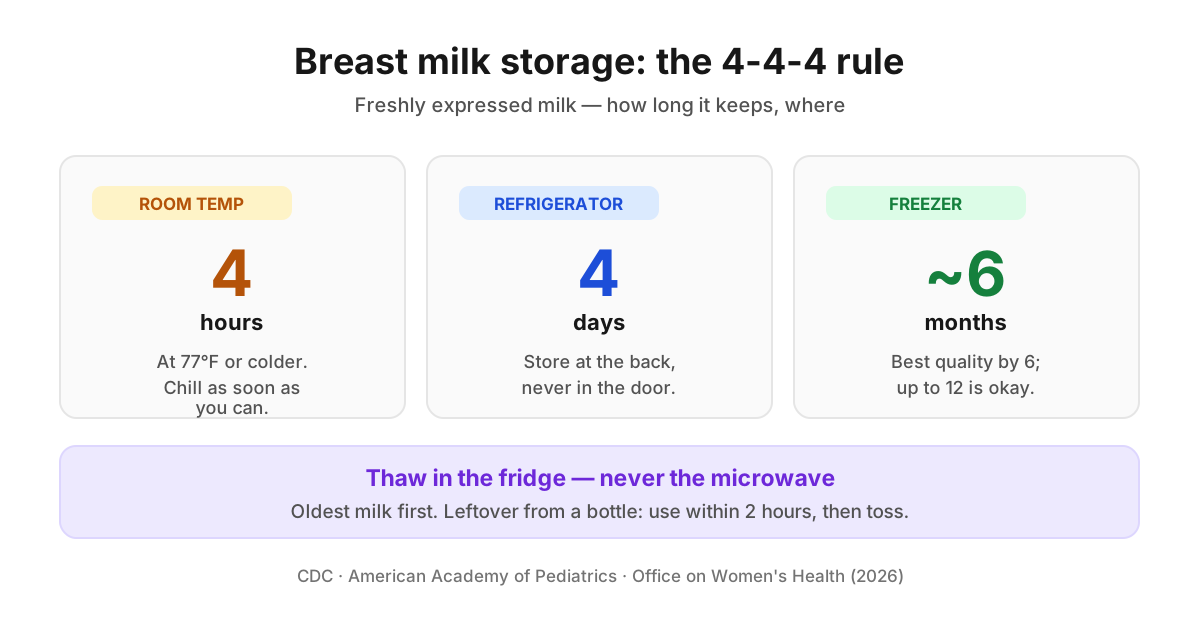
Breast milk is not as fragile as it feels. It contains live antibodies and enzymes that actively slow bacterial growth, which is why it keeps far longer than, say, cow's milk would under the same conditions. The CDC's storage guidelines give you the three numbers that matter most for freshly expressed milk:
- Room temperature (77°F or colder): up to 4 hours.
- Refrigerator: up to 4 days.
- Freezer: about 6 months for best quality, up to 12 months acceptable.
That's the "4-4-4" most parents memorize — 4 hours, 4 days, ~6 months — though the freezer number is really "about six is best, twelve is fine." The AAP's storage tips line up closely and add a useful nuance: very cleanly expressed milk can sit out a bit longer (6 to 8 hours), but it's always best to chill it as soon as you reasonably can. The numbers above are the safe, conservative defaults — use them and you don't have to think harder.
A few rules that prevent most milk-storage mistakes:
- Store toward the back, never in the door. The door is the warmest, most temperature-swingy spot in any fridge or freezer.
- Label every container with the date (and your baby's name if it's going to daycare).
- Store in small 2 to 4 ounce batches. The AAP recommends this specifically so you waste less — it's easier to thaw a little more than to pour a lot out.
- Leave room at the top of freezer bags, because milk expands as it freezes.
The two numbers people get wrong
The first is the leftover-bottle rule. Once your baby has started drinking from a bottle, bacteria from their mouth gets into the milk. The CDC says to use that leftover milk within 2 hours, then discard it. This is exactly why those 2-to-4-ounce batches pay off: a half-finished 6-ounce bottle is a real loss; a half-finished 3-ounce bottle barely stings.
The second is thawed milk. Once frozen milk has fully thawed in the refrigerator, use it within 24 hours, and never refreeze it. Milk that's been warmed (but not yet offered) should be used within about 2 hours. When in doubt, the order is always first in, first out — thaw your oldest dated milk first so nothing ages out in the back of the freezer.
How to thaw and warm without wrecking it
There is exactly one hard "never" here: never thaw or heat breast milk in the microwave. Microwaves heat unevenly, creating scalding hot spots that can burn your baby's mouth, and the high heat degrades some of the milk's protective properties.
Instead, pick whichever of these fits your morning:
- The night before: move tomorrow's milk from freezer to fridge to thaw slowly overnight.
- In a hurry: hold the sealed bag or bottle under cool-then-lukewarm running water, or set it in a bowl of warm (not boiling) water until it reaches body temperature.
Breast milk separates as it sits — the creamier fat rises to the top. That's completely normal. Gently swirl the bottle to remix it rather than shaking it hard. And don't be alarmed if thawed milk smells slightly soapy or metallic to you; that's a harmless enzyme (lipase) doing its job, and most babies drink it happily.
How often to pump
The governing principle of pumping is the same one that governs nursing: milk is made on demand. Your breasts make more milk when they're emptied often and signal "make less" when milk sits. So whether you're exclusively pumping or pumping at work, the goal is to mimic your baby's feeding rhythm rather than invent a new one.
For a young baby, that means pumping roughly every 3 hours across the day — about whenever you'd otherwise feed. The Office on Women's Health puts it plainly: at work, pump during the times you'd normally feed your baby, and remember that young babies feed 8 to 12 times in 24 hours. For a typical 8-hour workday, that usually shakes out to 2 to 3 pumping sessions of about 15 to 20 minutes each.
The AAP's pumping-at-work guidance adds the single most important supply tip: when milk seems to stop flowing, keep going for at least 10 minutes anyway. Those last few minutes trigger the let-downs that protect your supply over time. The most common reason supply dips for working parents is simply skipping or rushing sessions — so guard that pump time like a meeting you can't move.
If you want to nudge supply up — say, to build a stash — power pumping can help: in one session, pump 20 minutes, rest 10, pump 10, rest 10, pump 10. It mimics a cluster-feeding baby and tells your body to ramp production. Once a day for a few days is plenty; you don't need to live on the pump.
Building a stash (without going overboard)
The freezer-stash arms race is largely a myth. You do not need a chest freezer packed with milk before you return to work. Here's the math that makes it click: every workday, you pump roughly what your baby will drink the next day. So you're not living off the stash — you're living off a one-day rolling supply, and the stash is just a small cushion for the days a session gets cut short or you're running low.
A realistic plan:
- Start about 2 weeks before you go back, not the day after birth. Early on, your focus is establishing supply and recovering.
- Add one pumping session a day, ideally in the morning, when supply tends to be highest — try about an hour after your baby's first feed.
- Bank one extra ounce or two a day. Over two weeks, that quietly becomes enough bottles for your first day back plus a buffer.
- Practice the actual logistics before day one: pumping feels different from nursing, so the OWH recommends getting comfortable with your pump at home, in a low-stress setting, ahead of time.
If tracking which dated bags to thaw next starts to feel like a part-time job, that's exactly the kind of thing the TinyWins app can hold for you — log pumping sessions and bottle amounts so you can see your rolling supply at a glance instead of doing freezer-bag archaeology at 6 a.m.
Your rights at work
This part isn't optional kindness from your employer — it's federal law. Under the PUMP Act (an expansion of the older Break Time for Nursing Mothers law), most employees are entitled to reasonable break time to pump and a private space that is not a bathroom, for up to one year after your baby is born, as the OWH explains. You're allowed to use your existing breaks and lunch for this, and the space has to be shielded from view and free from intrusion.
Talk to your manager or HR before your first day back, not during a panicked Tuesday. A short, specific conversation — "I'll need about 20 minutes around 10, 1, and 4, and a private space" — almost always lands better than improvising.
When to call someone
Most pumping questions are logistics, not emergencies. But a few situations are worth a call — to a lactation consultant, your OB, or your baby's pediatrician:
- Your supply drops noticeably despite regular pumping, or you can never seem to pump "enough." Supply worries are often fixable with technique, flange fit, or schedule tweaks — and sometimes the number you pump simply doesn't reflect what your baby gets directly.
- Pumping hurts. It shouldn't. Pain usually means the wrong flange size or suction set too high.
- You notice a hot, red, painful area on your breast, especially with fever or chills — that can be mastitis and is worth a same-day call. (We cover this in breastfeeding problems, solved.)
And if exclusive pumping or formula ends up being the right call for your family — for supply, for work, for your own well-being — that is a complete and valid way to feed a baby. If guilt is creeping in, formula feeding without guilt is for you. The method matters far less than a fed baby and a parent who's still standing.
This article is educational and not medical advice. Always check with your pediatrician/provider.