It's 2 a.m., you've just fed your baby, and a warm cascade of milk comes back up and soaks through your shirt, the burp cloth, and somehow also the couch. You start to wonder: is something wrong with my baby's stomach? Is this acid reflux? Should you be doing something about it?
Here's the short, reassuring version: for most babies, spit-up is a laundry problem, not a disease. About half of all babies spit up regularly in their first three months, and the vast majority are what pediatricians affectionately call "happy spitters", babies who erupt like tiny volcanoes and then smile at you, utterly unbothered. Let's separate the normal-but-messy from the actually-concerning, and cover what genuinely helps (and one popular fix that's dangerous).
What the science says: GER versus GERD
Two acronyms do a lot of work here, and knowing the difference takes most of the worry out of the equation.
GER (gastroesophageal reflux) is just the medical name for stomach contents coming back up into the esophagus. In babies, this is normal and extremely common. The reason is plain anatomy: the ring of muscle at the top of the stomach, the lower esophageal sphincter, is still immature, so it doesn't seal as tightly as an adult's. Add a liquid diet and a lot of horizontal time, and milk comes back up easily. As Mayo Clinic notes, this is why about half of babies spit up in those early months. It's a plumbing-not-yet-finished situation, and it finishes on its own.
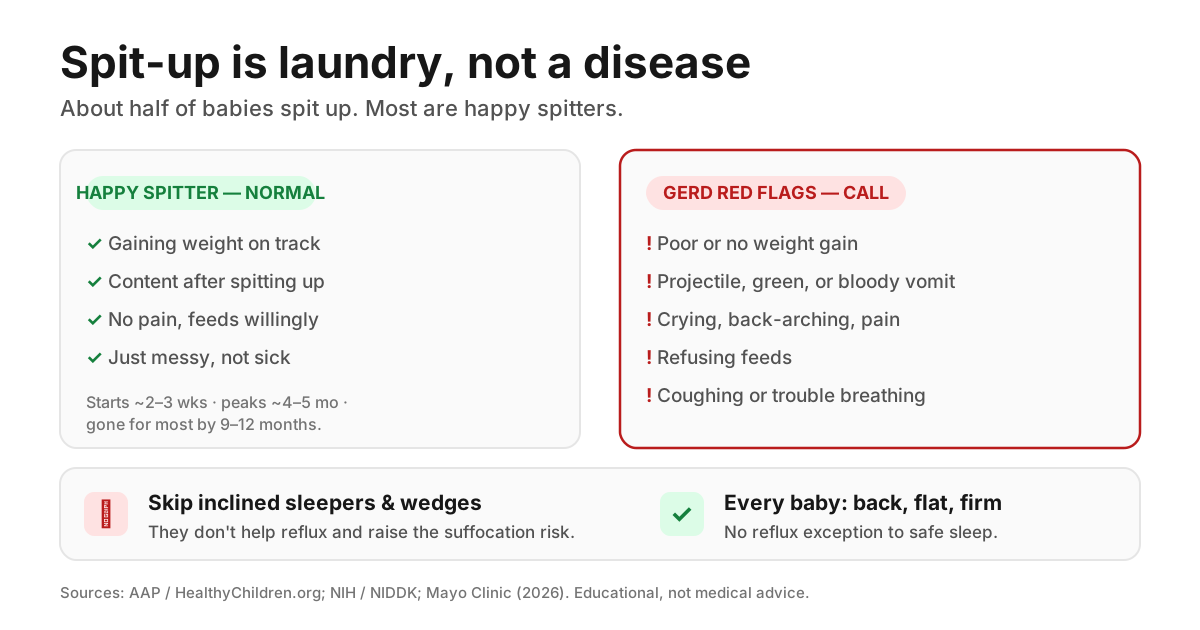
GERD (gastroesophageal reflux disease) is the disease version: reflux that causes bothersome symptoms or complications, per NIDDK. The distinction is the whole ballgame. GER is a happy spitter who's gaining weight. GERD is a baby in pain, not feeding well, not gaining, or showing other warning signs. Most spitty babies have GER. Only a minority have GERD.
The timeline that should reassure you
The American Academy of Pediatrics lays out a predictable arc:
- Spit-up usually starts around 2 to 3 weeks of age.
- It peaks around 4 to 5 months (yes, it can get worse before it gets better, which surprises a lot of parents around the 4-month mark).
- It resolves in most full-term babies by 9 to 12 months as the sphincter matures and as babies spend more time upright and start solids.
So if your 8-week-old is spitting up constantly, the science says: this is on schedule, and the schedule has an end date.
A quick, trustworthy explainer
If you'd rather hear this from a children's hospital than read it, this short clip walks through what reflux is and when it's worth a closer look:
What actually helps a happy spitter
You can't switch off an immature muscle, but you can reduce the volume and frequency of the eruptions. The AAP and Mayo Clinic recommend a handful of free, low-effort moves:
- Feed smaller amounts, more often. A stomach that's less full has less to send back up. Overfeeding is one of the most common drivers of big spit-ups.
- Burp during and after feeds. Pause partway through to let trapped air out, then burp again at the end. A burp on the way up brings less milk with it than a burp on the way back.
- Keep baby upright for about 20 to 30 minutes after eating. Gravity is your friend here. Hold them against your shoulder or sit with them; this is the single most reliable trick.
- Skip the post-feed gymnastics. Bouncing, car seats that fold them in half, and jostling right after a feed all encourage spit-up. Give it a beat before the activity.
- Thickening feeds (or any feeding change) only on your pediatrician's advice. Don't add cereal to bottles on your own; it's a real intervention with real considerations, and it's a doctor's call.
If you're not sure whether the spit-up is improving or getting worse over the weeks, jotting feeds and notes in the TinyWins app gives you an actual record to show your pediatrician, instead of trying to reconstruct three weeks of foggy, sleep-deprived memory at the visit.
The inclined-sleeper trap: please don't
Here is the one place we drop the friendly tone, because it matters. You will see inclined sleepers, crib wedges, "anti-reflux" positioners, and advice to prop up the mattress. Do not use them.
Inclined sleep products have not been shown to help infant reflux, and they carry a genuine suffocation and airway-obstruction risk. A baby on an incline can slump into a position that blocks their airway, and inclined sleepers have been linked to infant deaths and pulled from the market. The safe-sleep rule does not bend for reflux: every baby, including a spitty one, sleeps on the back, on a flat and firm surface, with nothing added, every time. (Worried about choking on spit-up while on their back? Babies have a protective reflex that clears the airway; back-sleeping does not raise choking risk, and it dramatically lowers the risk of SIDS.) For the full picture, see safe sleep ABCs.
The safest place for a reflux baby to sleep is exactly the same as for any other baby. There is no special reflux exception.
When to seek help: the GERD red flags
Most spit-up needs nothing but a burp cloth and patience. But call your pediatrician if you see any of these signs, which point toward GERD or another issue rather than ordinary reflux. The AAP and Mayo Clinic flag:
- Poor weight gain, or weight loss. This is the single most important signal. A baby who spits up but grows well is fine; a baby who isn't gaining needs evaluation.
- Forceful or projectile vomiting (shooting out, not dribbling), especially if it's new or worsening.
- Green or yellow vomit, or blood in the spit-up or stool.
- Frequent crying, back-arching, and what looks like pain with feeds.
- Refusing to feed, or feeding that has become a battle.
- Coughing, wheezing, or trouble breathing, or choking and gagging episodes.
Trust your read on your own baby. "Happy spitter" describes a content baby; if yours seems genuinely miserable around feeds, that's worth a conversation regardless of the checklist.
And separately from reflux: in a baby under 3 months, a rectal temperature of 100.4°F (38°C) or higher is always an urgent call, no matter what else is going on. See newborn fever: when to worry.
The bottom line
For most babies, spit-up is messy, loud, and completely benign, a normal phase that starts around 2 to 3 weeks, peaks near 4 to 5 months, and clears by 9 to 12 months. Feed smaller and more often, burp well, and keep your baby upright after meals. Skip the inclined sleepers entirely. And watch for the GERD red flags, poor weight gain above all, that turn "happy spitter" into "worth a call." Until then, stock up on burp cloths, and know that the volcano phase is temporary.
This article is educational and not medical advice. Always check with your pediatrician/provider.