It's 6 p.m., your toddler just bit their sibling, and the words rising in you sound exactly like the ones your own parents used. Most of us were raised with some version of spanking, and the instinct runs deep. So here's the reassuring part up front: the most effective discipline in the research is also the kindest — and none of it requires hitting your child.
"Discipline" comes from a root meaning to teach, not to punish. The goal isn't to make a toddler sorry; it's to help a still-under-construction brain learn how to behave. Here's what the evidence says actually does that.
What the science says about spanking
This is the rare parenting question where the research is not close. After reviewing decades of studies, the American Academy of Pediatrics issued a clear policy statement, Effective Discipline to Raise Healthy Children, recommending that parents not use spanking, hitting, slapping, or any form of physical punishment — and not use yelling, shaming, or humiliation either.
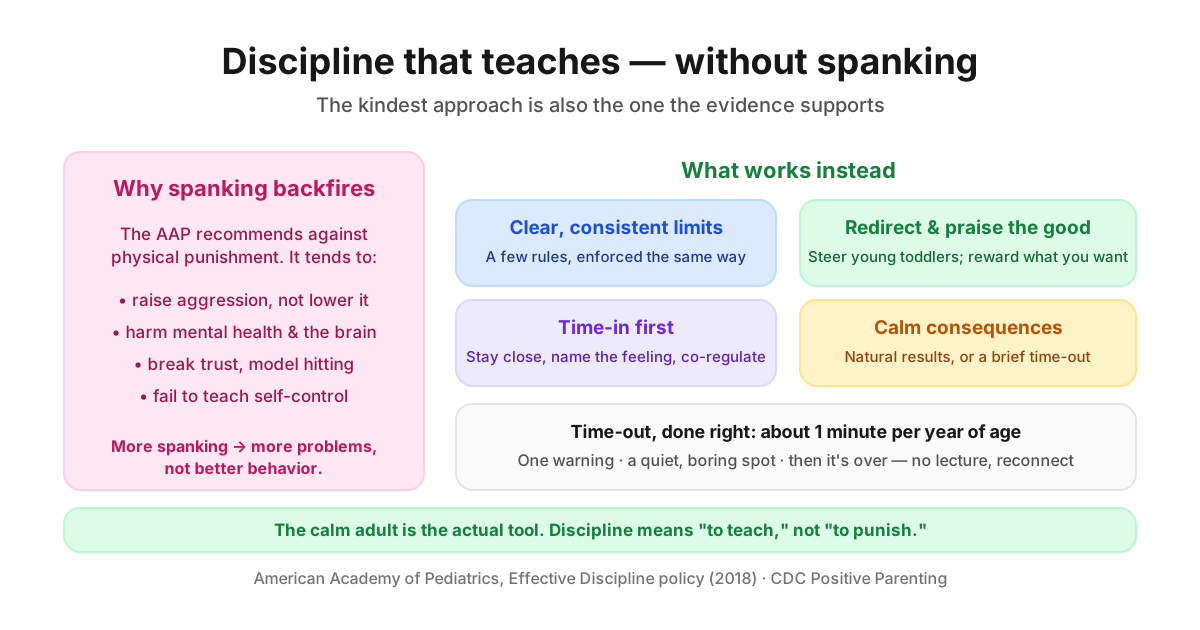
Why so firm? Because spanking doesn't do what we hope it does. The AAP's review found that physical punishment is ineffective at teaching long-term self-control and is associated with worse outcomes over time:
- More aggression, not less. Children who are spanked tend to become more aggressive and defiant, not better behaved. The pattern is dose-dependent: the more spanking, the more behavior problems down the road.
- Higher risk to mental health and development. Physical punishment is linked to increased risk of mental health problems and even measurable effects on the developing brain.
- A damaged relationship. It teaches a child to fear you and to hide, rather than to trust and learn — and it models hitting as a way to solve problems.
There's also a simple in-the-moment reason it fails: a young toddler in meltdown has, as we cover in the science of tantrums, a fully-online "feeling brain" and a barely-built "thinking brain." Punishment lands on a brain state the child cannot exit on command. You can't spank a toddler into having a mature prefrontal cortex.
If you've spanked, this isn't a verdict on you. Most parents who do are tired, triggered, and acting on instinct — and the research says switching approaches helps at any age. The good news is the alternatives work better.
The discipline that actually works
Both the AAP and the CDC point to the same boring-but-powerful toolkit. None of it is complicated. All of it takes practice.
1. Set a few clear, consistent limits
Toddlers thrive on knowing where the edges are. Pick a small number of rules that genuinely matter (safety, kindness, not destroying things), state them simply, and — this is the hard part — enforce them the same way every time. A limit that holds on Tuesday and folds on Friday teaches a toddler to keep pushing. Consistency, not severity, is what makes a limit stick.
2. Redirect and prevent
For the under-2 crowd especially, the most effective tool is redirection: calmly move them (or the object) and offer something else. "Not the lamp — here's your stacking cups." A baby-proofed, "yes" environment prevents a huge share of conflicts before they start, which the CDC lists among its first positive parenting tips. You're not avoiding discipline — you're removing the need for it.
3. Catch them being good
The single most underused move in parenting is specific praise for the behavior you want to see more of. "You waited so patiently while I was on the phone — thank you." Attention is the most powerful reward a toddler has, and whatever you give attention to grows. Praising cooperation works far better than punishing its absence, because it tells the child exactly what to do, not just what to stop.
4. Use "time-in" before "time-out"
For the emotional flooding behind most toddler misbehavior, the first response is connection, not isolation. A time-in means staying close, getting down to their level, helping them name the feeling ("you're so mad the tower fell"), and co-regulating until the storm passes. Many toddlers don't need a consequence at all once they're calm — they needed help getting there.
5. Let natural and logical consequences teach
When it's safe, the world is a better teacher than a lecture. A natural consequence: refuse your coat, feel a little cold, learn something. A logical consequence, set calmly by you: throw the blocks, the blocks go away for now. Consequences work best when they're related to the behavior, immediate, and delivered without anger — as information, not vengeance.
How time-outs actually work
Time-out has a bad reputation it mostly doesn't deserve — because it's so often done wrong, as a dramatic banishment. Done right, per the AAP's guidance, it's simply a short, boring break from attention and activity that lets everyone reset. It works from roughly age 2 to 3, once a child can grasp simple cause and effect.
The mechanics that make it effective:
- Pick one or two specific behaviors ahead of time (like hitting), so it's predictable, not a surprise ambush.
- Give one calm warning. "If you hit again, you'll have a time-out." Then follow through — every time.
- Keep it short: about one minute per year of age. Roughly 2-3 minutes for a toddler. Longer isn't more effective; it just becomes a power struggle.
- Make it boring, not scary. A quiet, safe spot with no toys, no screen, no audience. The "punishment" is the absence of attention, nothing more.
- When it's done, it's done. No lecture, no demand for an apology. Briefly restate the rule, then move on and reconnect. The goal is a reset, not shame.
If time-outs turn into wrestling matches, that's a sign your toddler may be too young or too dysregulated for it in that moment — circle back to time-in and try again when they're calmer.
Take care of yourself, too
Here's the part the toolkits underplay: the calm adult is the actual tool. Every approach above depends on you keeping your own temper, and no one manages that on no sleep and no support. If you feel yourself about to lose it, it's completely legitimate to put your child somewhere safe, step away for a moment, and breathe before you respond.
This is genuinely hard, and consistency is the whole game — which is exactly why it helps to track what's working and get guidance matched to your child's stage. That's part of what we built TinyWins for: short, evidence-based steps for the developmental phase your toddler is actually in, so the limits you set fit the kid in front of you.
When to talk to your pediatrician
Most toddler defiance is normal development, not a problem to fix. But check in with your pediatrician if:
- Your child's behavior is aggressive enough to regularly hurt others or themselves, or destroys property, beyond the occasional outburst.
- The defiance is severe, frequent, and not improving with consistent, calm limits over time.
- Behavior changes come with language delays, loss of skills, or other developmental concerns — worth flagging early, as we cover in developmental red flags and early intervention.
- You're struggling — feeling like you can't stay calm, finding yourself hitting or yelling more than you want to, or just running on empty. Asking for help is good parenting, not failure. Your pediatrician can connect you with positive-parenting programs that measurably lower day-to-day conflict, with zero judgment.
The long game is this: every limit you hold calmly, every feeling you help name, every "good job waiting" is a rep. You're not just getting through 6 p.m. — you're teaching a small person how to manage themselves, using your steadiness as the scaffolding. That's discipline doing what the word actually means.
This article is educational and not medical advice. Always check with your pediatrician/provider.