It's the most-Googled question of the first year, usually typed one-handed at 2 a.m. while the other arm holds a sleeping baby: is my baby on track? The honest answer is reassuring and a little frustrating at the same time — almost certainly yes, and there's a wide range of "yes."
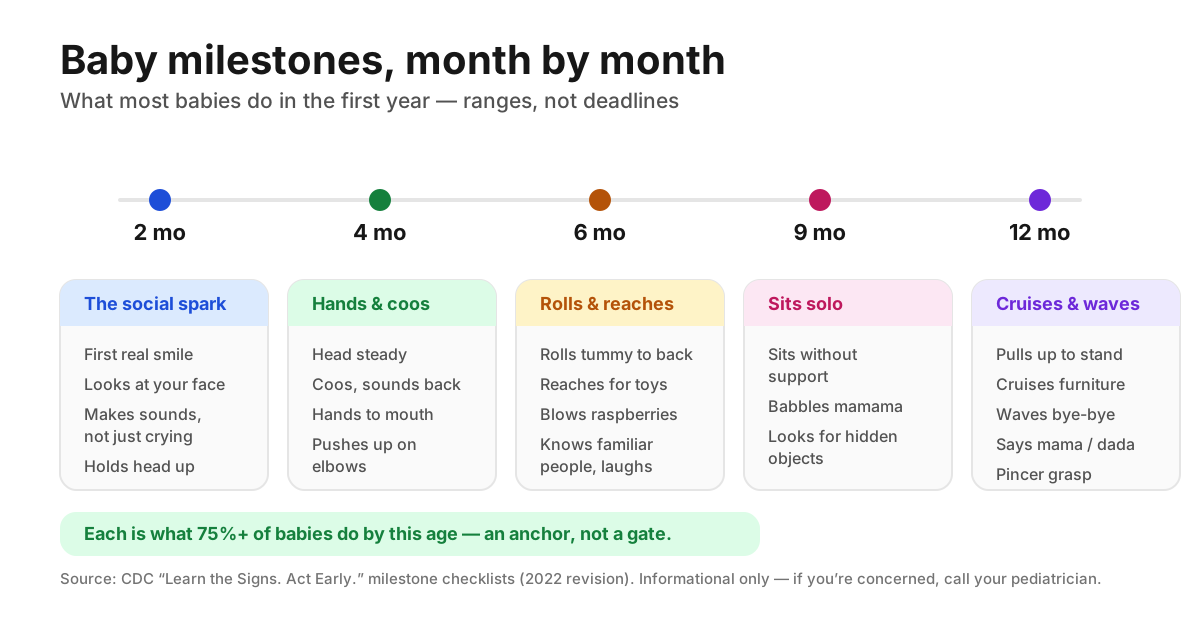
Here's what most babies do at each stage in the first year, pinned to the current CDC checklists, plus the part the listicles skip: what counts as a real reason to call your pediatrician, and how prematurity changes the math.
What "milestone" actually means
A developmental milestone isn't a finish line your baby is racing toward. The CDC defines its checklists as the things 75% or more of children can do by a given age — in other words, what most babies do, not what all babies must do (CDC).
That 75% framing matters. It means a quarter of perfectly healthy babies haven't done a given thing yet on the day the checklist names — and they're still completely typical. Development is a sequence, not a schedule: babies hit the same milestones in roughly the same order, but months apart from each other. One baby walks at 9 months, another at 15, and both are right on track.
So read what follows as anchors, not gates. The goal isn't a baby who matches the calendar — it's a baby who keeps moving forward, one step at a time.
2 months: the social spark
The newborn fog starts to lift. Around 2 months, the headline is the first real social smile — not gas, but a smile aimed at you when you talk or smile at them. The CDC's 2-month checklist lists babies who:
- Calm down when spoken to or picked up, and look at your face
- Smile when you talk to or smile at them, and seem happy to see you
- Make sounds other than crying and react to loud sounds
- Hold their head up during tummy time and move both arms and both legs
If tummy time is mostly a protest at this stage, you're in good company — short, frequent sessions are how that neck strength gets built.
4 months: hands, coos, and pushing up
By 4 months your baby is becoming an active participant. The CDC's 4-month checklist describes babies who:
- Smile on their own to get your attention and make sounds back when you talk to them
- Coo ("oooo," "aahh") and turn toward the sound of your voice
- Hold their head steady without support when you're holding them
- Bring hands to mouth, hold a toy you place in their hand, and push up onto elbows on their tummy
This is the stage of glorious drool and everything-goes-in-the-mouth — which, despite appearances, is real cognitive work. (It is not, on its own, a sign that solids are due; readiness for solids is its own checklist, covered in our guide to starting solids.)
6 months: rolling, reaching, raspberries
The halfway mark is a big one. The CDC's 6-month checklist lists babies who:
- Roll from tummy to back and push up with straight arms on their tummy
- Lean on their hands to support themselves when sitting
- Reach to grab a toy they want and put things in their mouth to explore
- Take turns making sounds with you, blow raspberries, and make squealing noises
- Know familiar people, laugh, and like to look at themselves in a mirror
Notice what's not here: sitting up unassisted and crawling aren't 6-month milestones. They're coming — just not quite yet for most babies.
9 months: sitting solo and stranger danger
Around 9 months, your baby gets genuinely mobile and genuinely opinionated about who's holding them. The CDC's 9-month checklist describes babies who:
- Sit without support and get to a sitting position by themselves
- Move things from one hand to the other and rake food toward themselves with their fingers
- Look for objects when they're dropped out of sight (object permanence is online)
- Babble strings like "mamamama" and "bababababa" and look when you call their name
- Show several facial expressions — happy, sad, angry, surprised
- Are shy, clingy, or fearful around strangers and react when you leave
That last one surprises parents: the new clinginess and tears at drop-off aren't a regression. Separation anxiety is a sign of healthy attachment — your baby now understands that you exist even when you've left the room, and would very much like you to come back.
12 months: standing, waving, and "mama"
The first-birthday checklist is where the baby starts to look like a little person. The CDC's 1-year checklist lists babies who:
- Pull up to stand and walk while holding on to furniture (cruising)
- Pick things up between thumb and pointer finger — the pincer grasp that makes self-feeding possible
- Wave "bye-bye" and call a parent "mama" or "dada" (or another special name)
- Understand "no" (pause or stop, at least briefly) and play games like pat-a-cake
- Put something in a container, like a block in a cup, and look for things they see you hide
Note that independent walking is not a 12-month milestone — the checklist tops out at cruising, because typical first steps land anywhere from about 9 to 15 months. If your one-year-old is cruising the coffee table but not walking solo, that's textbook.
The crawling myth (and other detours)
Here's the thing nobody tells you: crawling isn't on the CDC checklist at all. Plenty of healthy babies never do a classic hands-and-knees crawl — they scoot on their bottoms, roll across the room, "commando" crawl on their bellies, or skip straight from sitting to pulling up to walking. Pathways.org, which builds its milestones from CDC and AAP materials, treats mobility as the goal, not any one technique. What matters is that your baby is finding some way to move and explore — not the style.
Keeping track of this can be genuinely hard, because the first year is a blur and the milestones blend together. Checking each one off as it appears — which is how milestone tracking works in TinyWins — turns the pediatrician's "any concerns?" from a panicked "um, I think so?" into an actual answer, and unlocks the content that's relevant to your baby right now instead of an average one.
This short CDC video explains why watching these milestones — and acting early on concerns — matters more than hitting any single date:
If your baby was born early
If your baby arrived before their due date, judge their milestones against their corrected age, not their birthday. The AAP's formula is simple: subtract the number of weeks your baby was born early from their actual age (AAP). A baby who is 6 months old but was born 8 weeks early is developmentally closer to a 4-month-old — and should be expected to do roughly 4-month things.
Use corrected age until about 2 years old, by which point most children born preterm have caught up to the typical range. Your pediatrician will track this with you at every visit, so you don't have to do the math alone.
When to call your pediatrician
Most "behind" babies aren't behind at all — they're on the late-but-normal end of a wide range. But the CDC is clear that "wait and see" is not the strategy when something feels off. Their guidance is to act early (CDC).
Call your pediatrician promptly if your baby:
- Loses a skill they used to have — babbling, smiling, reaching. Loss of skills at any age always warrants a prompt conversation, never a wait.
- Isn't responding to sounds, your voice, or their own name as they get older
- Has stiff, tight muscles or seems very floppy
- Isn't making progress toward the next stage over a stretch of weeks
- Just generally worries you — your gut is data
When you call, name the specific milestone and ask about developmental screening. The AAP recommends formal screening at the 9-, 18-, and 30-month visits, and any time a parent has a concern (CDC). In the US, you can also self-refer to your state's free Early Intervention program — no doctor's referral required. Evaluation is harmless, it's free, and early support is the most effective support.
If you want the fuller picture of warning signs across the toddler years and exactly how to get a free evaluation, see our guide to developmental red flags and early intervention. And if you're wondering why we keep saying "ranges, not dates," that's the whole idea behind building around milestones instead of ages.
The first year is a sequence your baby is working through at their own pace. Your job isn't to make them match the calendar — it's to celebrate each step as it comes, and to trust your gut enough to ask when something feels off.
This article is educational and not medical advice. Always check with your pediatrician/provider.