The nurse writes a number on a sticky note — "32nd percentile" — and hands it to you like it's a test score. By the time you're in the parking lot, you've already googled it twice and your stomach has dropped. Is 32 bad? Your sister's baby was at the 75th. Should yours be eating more? Welcome to the single most misread number in all of parenting: the growth percentile, a perfectly neutral statistic that has caused more 11 p.m. spirals than almost anything else.
So let's defuse it. This is a tour of the well-child visit — what actually happens at each checkup from the newborn days through age five, why there are so many of them up front, and the part parents most need: how to read a growth chart the way your pediatrician does. The headline, which we'll earn below, is this: the trend is the story, not the number.
What the science says about the visit schedule
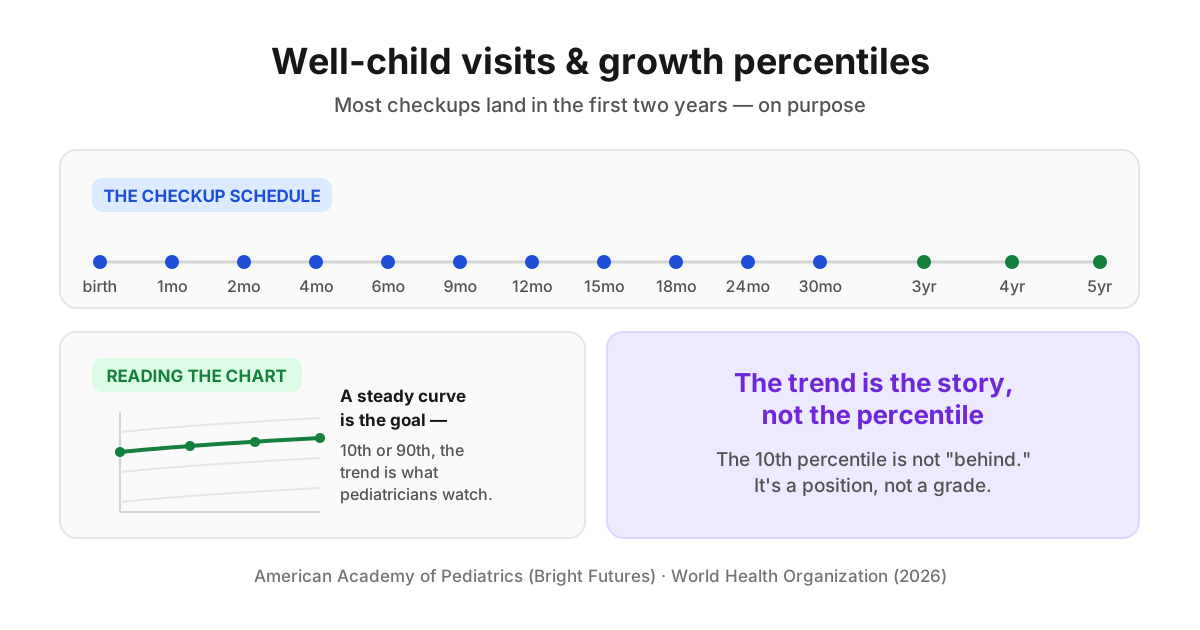
Well-child visits aren't arbitrary. They follow the AAP/Bright Futures schedule, a periodicity schedule pediatricians across the country share. After the newborn check in the hospital, the cadence runs:
- 3 to 5 days old (a quick weight-and-feeding check right after discharge)
- 1, 2, 4, 6, 9, 12, 15, 18 months
- 24 months and 30 months
- Once a year from age 3 onward
If it feels like you're at the pediatrician constantly in year one, you are — and there's a reason. The first two years are when babies grow fastest, hit developmental milestones in rapid sequence, and receive the bulk of the childhood immunization schedule. Frequent visits let your pediatrician catch small things early, when they're easiest to address, and give you a built-in expert to ask at every stage.
What actually happens at each checkup
Different ages, same basic rhythm. Nearly every well visit includes five things:
- Measurements. Weight, length or height, and (under age 2 or 3) head circumference. These get plotted on a growth chart — more on reading that below.
- A physical exam. A head-to-toe check: heart and lungs, hips, eyes, ears, mouth, belly, skin, reflexes, and for babies, the soft spot (fontanelle).
- Developmental and behavioral screening. Often a short questionnaire you fill out about what your child is doing. Autism-specific screening happens at 18 and 24 months. This is where milestones get reviewed — though remember that milestones describe ranges, not deadlines.
- Immunizations. Any vaccines due at that age, sometimes the part nobody loves but matters most.
- Anticipatory guidance. The pediatrician's heads-up about what's next: introducing solids, baby-proofing, sleep changes, car-seat transitions, screen time. As the AAP describes it, these visits are about prevention, tracking growth and development, addressing concerns, and building a trusting relationship over time.
Make the visit work for you
The 15 minutes go fast, so come prepared. A few habits that pay off:
- Write your questions down in advance. The thing you most wanted to ask is exactly the thing you'll forget when your toddler is melting down on the exam table.
- Bring your top 2 or 3 concerns to the top. Sleep, eating, a behavior, a rash you keep meaning to mention.
- Track between visits. Logging feeds, sleep, and the milestones you're seeing in the TinyWins app means you walk in with real patterns instead of "um, I think she's been waking more?" — and the doctor gets a far clearer picture.
- Be honest. Pediatricians have heard it all. Underreporting how rough things are (or how worried you are) only makes it harder for them to help.
How to read a growth chart
Here's the part that ends the parking-lot panic. A growth chart is just a set of curved lines — the percentiles — with your child's measurements plotted as dots over time. A percentile ranks your child against 100 peers of the same age and sex. The 40th percentile for weight means your baby weighs more than about 40 of those 100 children and less than 60. That's it. It is a position, not a grade.
The AAP is blunt about this: "Unlike school grades that we hope are always as high as possible, for growth we hope for consistency." There is no prize for the 90th percentile and no penalty at the 10th. Somebody is always going to be the smallest healthy kid in the class, and a baby who has tracked happily along the 15th percentile since birth is growing exactly right.
So if the number isn't the point, what is? The trend — your child's own curve over time. Pediatricians plot dot after dot, visit after visit, and look at the shape of the line your baby is drawing. A baby who follows their own percentile band steadily, whether that's the 10th or the 75th, is the picture of healthy growth.
What "crossing percentiles" actually means
This is the nuance worth understanding. Some crossing of percentile lines is completely normal, especially in the first 2 to 3 years, as babies move off their birth size (which reflects the womb environment) and settle onto their own genetic curve. A big baby of small parents may drift down; a small baby of tall parents may climb. That's the chart working as intended.
What gets a closer look is a clear, sustained shift across multiple lines — a steady drop, or a sudden jump — that doesn't fit the overall picture. Even then, it's a prompt to look, not a diagnosis. Your pediatrician reads the chart alongside everything else: feeding, energy, wet diapers, development, and your family's natural sizes. One dot never tells the story; the line does.
Why there are two different charts
You may notice your baby's chart changes around age 2. That's intentional. Per the AAP, U.S. pediatricians use the WHO Child Growth Standards from birth to age 2, then switch to the CDC charts from age 2 onward. The distinction matters: the WHO charts are a standard, not just an average. They were built from the WHO Multicentre Growth Reference Study — healthy, breastfed babies raised in optimal conditions across multiple countries — so they describe how children should grow given good nutrition and care, rather than simply mirroring how a population happens to grow. It's a "this is healthy" benchmark, which is exactly what you want for an infant.
When growth (or a visit) raises a real flag
Most percentile worry is unfounded. But there are moments to actively raise it with your pediatrician — ideally at the visit, or sooner with a call:
- A sustained drop across percentile lines, or a baby who isn't gaining weight as expected between visits.
- Far fewer wet diapers, a baby who seems persistently lethargic, or feeding that's become a real struggle — these say more than any chart.
- A milestone your child has clearly missed by a wide margin, not just edged past the average. The developmental red flags worth acting on — and the early-intervention systems that help — are covered separately, and the rule there is the same as everywhere in pediatrics: when in doubt, ask early. Early is always better.
And if a number ever sends you spiraling, bring it to the visit instead of the search bar. The whole point of a pediatrician who has watched your child's curve grow, dot by dot, is that they can tell you — with context you can't get from a percentile alone — whether the line your baby is drawing is exactly the right one. It usually is.
This article is educational and not medical advice. Always check with your pediatrician/provider.