Somewhere between their first and second birthday, most toddlers pull off one of the most remarkable feats in human development: they go from a handful of wobbly first words to dozens of words and original two-word sentences — often with a dramatic acceleration partway through that researchers call the vocabulary spurt and parents call "where did she learn THAT?"
Here's what's typical, what actually fuels the boom, and the specific signs that mean it's time to ask for a speech evaluation.
The typical timeline (with honest ranges)
Language development has some of the widest "normal" ranges in all of child development. With that caveat:
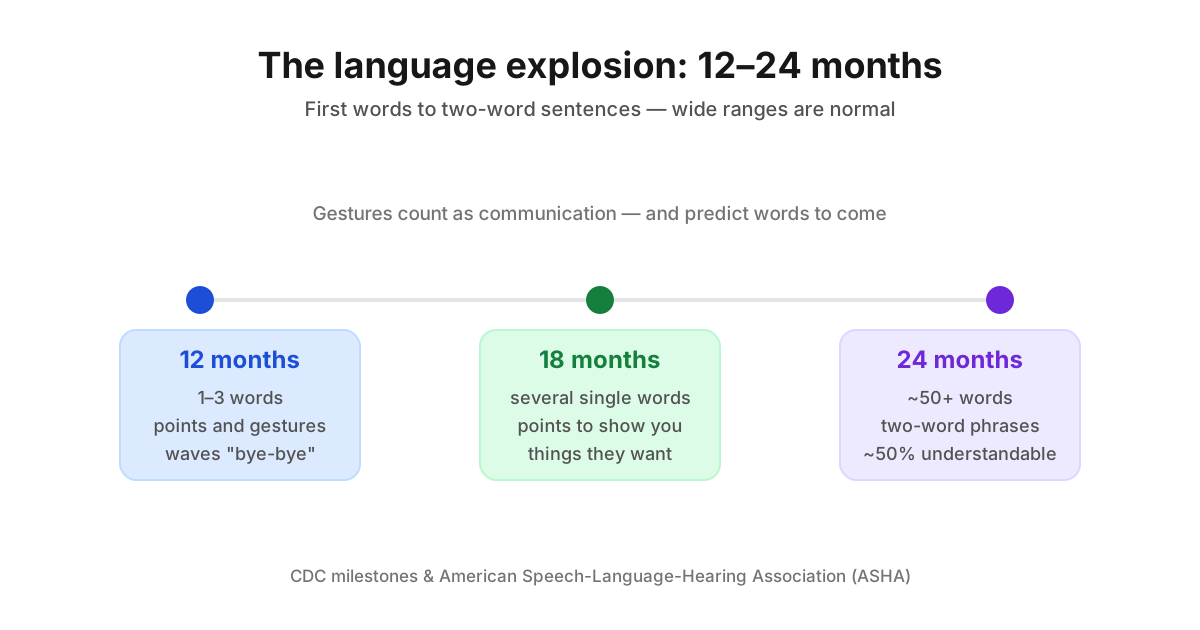
- Around 12 months: first true words appear — and "words" includes consistent approximations like "baba" for bottle. The AAP notes that at this age understanding races ahead of speaking: toddlers follow simple directions and recognize names of familiar people and objects long before they can say them.
- Around 18 months: many toddlers use somewhere in the range of 10–25 spoken words, per ASHA's communication milestones, and they're adding more — including by imitating words they hear (consider yourself warned).
- By 24 months: most toddlers say 50 or more words and — the big leap — combine two words into novel phrases: "more juice," "mommy shoe," "no bath." The AAP describes two-year-olds stringing words together and being understood by familiar adults much of the time.
The acceleration is real: many children add words slowly for months, then suddenly start picking up new words at a startling clip. Both the slow build and the spurt are normal patterns.
Gestures count (more than most parents realize)
Before and alongside words, toddlers communicate with pointing, waving, reaching, showing, and head-shaking — and these gestures aren't filler. They're language infrastructure. The CDC's 18-month checklist tracks gestures like pointing and waving "bye-bye" as developmental milestones in their own right, and speech-language pathologists treat a rich gesture repertoire as one of the strongest signs a late-talking child will catch up.
Conversely, ASHA flags limited gesture use as one of the key risk factors that distinguishes a "late bloomer" from a child with a language delay. A 15-month-old who points at the dog, looks at you, and waits for you to say something is doing language — just not out loud yet.
What actually fuels the explosion
No flashcards required. The evidence consistently points to ordinary, responsive interaction:
- Narrate and respond. Talk about what you're doing and what they're attending to ("You found the ball! It's a big red ball"). The NHS recommends following your child's focus and replying to their sounds and words — serve-and-return, not lecture.
- Expand, don't correct. Child: "Doggy run!" You: "Yes — the dog is running fast!" You've modeled the grammar without making speech a test.
- Read every day. Books concentrate rare words and shared attention. Same book 400 times is fine; repetition is how toddlers learn (AAP).
- Sing, rhyme, pause. Songs make word boundaries audible — and pausing before the last word of a familiar verse invites them to fill it in (NHS).
- Give wait time. Count three slow seconds after you ask something. Toddler word-retrieval is slow; silence is where their sentence is loading.
- Protect talk time from screens. Background TV measurably reduces parent–child talk — one reason screen-time guidance is what it is for this age group.
One practical note: it's surprisingly hard to remember whether your toddler said 12 words or 30 when the pediatrician asks. Checking words and gestures off as they appear — which is how milestone tracking works in TinyWins — turns "uh, some?" into an actual answer.
A speech-language pathologist from Pathways.org demonstrates these everyday talk-boosting moves in two minutes:
When to seek a speech-language evaluation
Most late talkers catch up. But "wait and see" is not the recommended strategy, because evaluation is harmless and delays are most treatable early. ASHA's guidance for children roughly 18–30 months highlights three risk factors that warrant a closer look:
- Limited understanding — your child doesn't seem to follow simple, familiar phrases without gestures
- Few gestures — little pointing, showing, waving, or other communicative gestures
- Slow word growth — vocabulary that isn't visibly expanding month over month
Add the consensus benchmarks: no first words by ~15–16 months, fewer than 50 words or no two-word combinations by 24 months, or any loss of previously acquired words at any age — that last one always merits a prompt conversation with your pediatrician. The 50-word figure comes from ASHA's milestones; the CDC's 2-year checklist lists "combines two words" as one of its 24-month communication milestones, and any loss of skills at any age is its own act-early flag.
Also rule out the quiet culprit: hearing. Even mild or fluctuating hearing loss (from chronic ear infections, for instance) can slow language. A hearing test is a standard first step in any speech evaluation (ASHA).
In the US, you can self-refer to your state's free Early Intervention program — no doctor's referral needed.
What about bilingual homes?
Speak your languages — all of them. A persistent myth holds that hearing two languages confuses toddlers or delays speech. ASHA is direct about this: using your home languages with your child will not cause or worsen speech or language problems, and a strong foundation in one language actually supports learning the next.
Two practical notes for bilingual families:
- Count words across both languages. A toddler who says "agua," "water," "más," and "more" has a four-word vocabulary for milestone purposes — and "agua/water" pairs each count separately.
- The milestones are the same. Bilingual toddlers babble, point, hit first words, and combine words on the same general timeline. A true delay shows up in both languages, which is why evaluations should always be done by someone who can assess the child's full language picture (ASHA).
The bigger picture
The 12–24 month language boom isn't an isolated party trick — it's connected to everything else happening in toddlerhood. Words are how toddlers will eventually negotiate instead of melting down on the kitchen floor, and the back-and-forth conversation skills built now are exactly what kindergarten readiness is made of years later.
So narrate the grocery store. Read the dinosaur book again. Answer the babble like it's a TED talk. The science says that's the program — and you're already running it.
This article is educational and not medical advice. Always check with your pediatrician/provider.