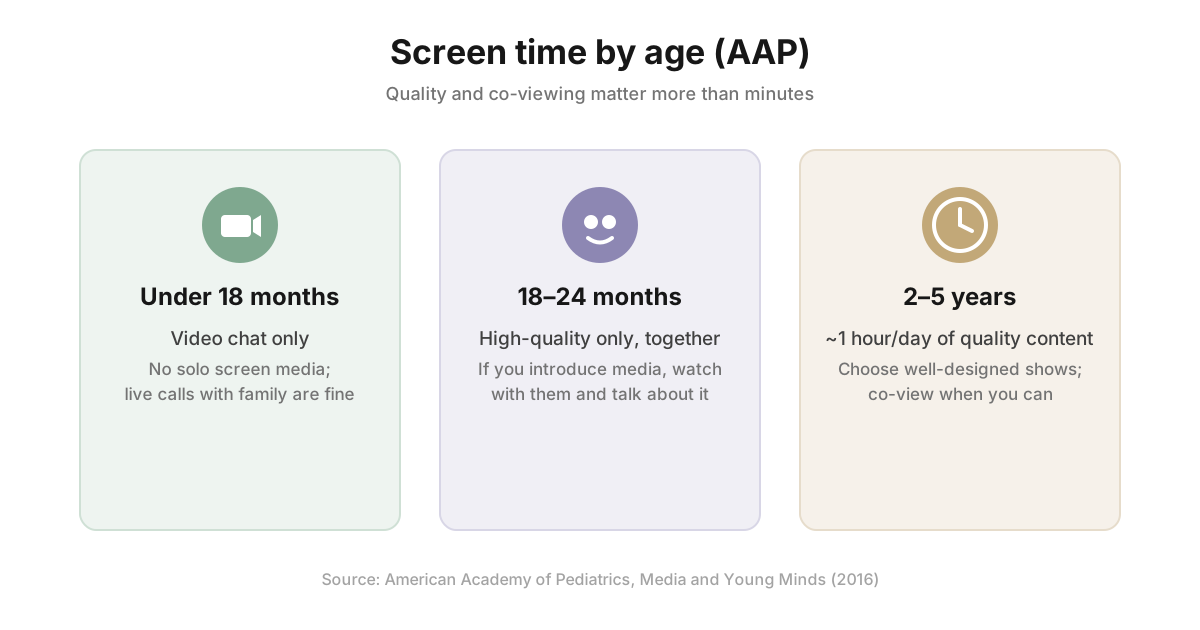
Few parenting topics generate more guilt per minute than screen time. So let's start with relief: the research-based guidance is not "screens will ruin your child." It's a set of age-based defaults from the American Academy of Pediatrics and the World Health Organization — plus one principle that matters more than any minute count: what they watch, and whether you're involved, beats how long the timer ran.
The guidance, age by age
Under 18 months: skip it — except video chat
The AAP's policy statement Media and Young Minds recommends avoiding screen media for children younger than 18 months, with one explicit exception: video chatting. A FaceTime call with grandma is interactive, responsive, and socially contingent — the ingredients infant brains learn from — which is why it's carved out.
Why so strict otherwise? Babies under ~18 months struggle with what researchers call the transfer deficit: they have difficulty translating what they see on a 2D screen into real-world knowledge. They learn dramatically more from the same content delivered by a live human. The WHO goes further, recommending no sedentary screen time at all for babies under 1 — its concern is also what screens displace: floor play, interaction, and sleep.
18–24 months: quality content, with you
If you want to introduce media in this window, the AAP advises choosing high-quality programming and watching it together — not handing over a device for solo viewing. At this age, your narration is the bridge: toddlers learn from screen content mainly when an adult re-teaches it ("That's a digger! We saw a digger today!").
This is also peak language-explosion territory, which raises the stakes on a related finding: background TV measurably reduces parent–child talk and degrades toddler play, even when nobody's watching it (AAP). Turning off the always-on TV is the cheapest language intervention in existence.
2–5 years: about an hour a day of good stuff
For preschoolers, the AAP recommends limiting screen use to around 1 hour per day of high-quality programming, co-viewed when possible (healthychildren.org). The WHO's guidance for ages 2–4 lands in the same place: no more than 1 hour of sedentary screen time, and less is better — framed inside a bigger prescription for more active play and protected sleep.
"High-quality" isn't marketing-speak. It means slower-paced, story-driven content designed for young children — think Sesame Street and Mister Rogers-style programming — rather than frenetic, algorithm-fed clips. The AAP specifically cautions that fast-paced content and apps stuffed with distracting interactive bells and whistles are poor fits for toddler attention systems.
Why co-viewing beats counting minutes
Across all of this guidance, one thread repeats: the adult is the active ingredient.
- Co-viewing turns passive watching into conversation — and conversation is what builds vocabulary and comprehension (AAP)
- A parent connecting screen content to real life ("we have apples like that!") is what makes content educational in practice, not just in the app-store description
- Watching together lets you filter what's actually in the content — autoplay has opinions you may not share
An hour of co-viewed, discussed, age-designed content and an hour of solo algorithmic video are simply not the same hour. The clock can't tell the difference. You can.
What the science worries about (it's mostly displacement)
The strongest, most consistent findings aren't "screens emit harm" — they're about what heavy screen use replaces: conversation, hands-on play, physical activity, and especially sleep. The AAP highlights evidence linking more media use — and screens in the bedroom — with shorter sleep in young children, and recommends no screens in the hour before bed and no devices in bedrooms (Media and Young Minds). If screens are colliding with bedtime at your house, our sleep training guide pairs well with this one.
The other documented trap is using screens as the only calm-down tool. The AAP cautions that toddlers who are always soothed with a device get fewer chances to practice regulating feelings themselves — the exact skill under construction during tantrum season.
"But the app says it's educational"
A quick filter for the app store, where "educational" is a marketing category, not a tested claim. The AAP's review of the evidence found that most apps marketed as educational for young children have no demonstrated efficacy, are built around rote skills, and lack the input from developmental specialists that well-designed programming gets. Three questions beat any badge:
- Could my child do this without the screen? Tracing letters on a tablet has a paper-and-crayon equivalent with better motor payoff.
- Does it demand interaction or just taps? Genuine contingency ("what sound does the cow make?" waits) is closer to how toddlers learn than tap-anywhere reward noises.
- Can we use it together? The strongest documented learning effects for under-3s come from joint use — which is co-viewing again, in app form.
A realistic family playbook
Perfection isn't the bar. Defaults are. The AAP's free Family Media Plan is built on exactly that idea — pick your rules in advance so you're not negotiating with a three-year-old at 6pm:
- Set the age-based default from the chart above, and treat it as a default, not a daily moral exam.
- Protect the big three: no screens during meals, the hour before bed, or in bedrooms.
- Kill background TV when no one is actively watching.
- Choose content like you'd choose a babysitter — slow, kind, designed for their age.
- Watch together when you can, talk about it when you can't ("What happened with Bluey today?").
- Audit your own use. Children's media habits track their parents' more than their parents' rules.
And when you swap screen minutes out, swap something in: the highest-value replacement activities for under-fives are unstructured play, reading, and conversation — which is why TinyWins fills its daily steps with two-minute, no-equipment play and talk ideas matched to your child's stage.
This article is educational and not medical advice. Always check with your pediatrician/provider.