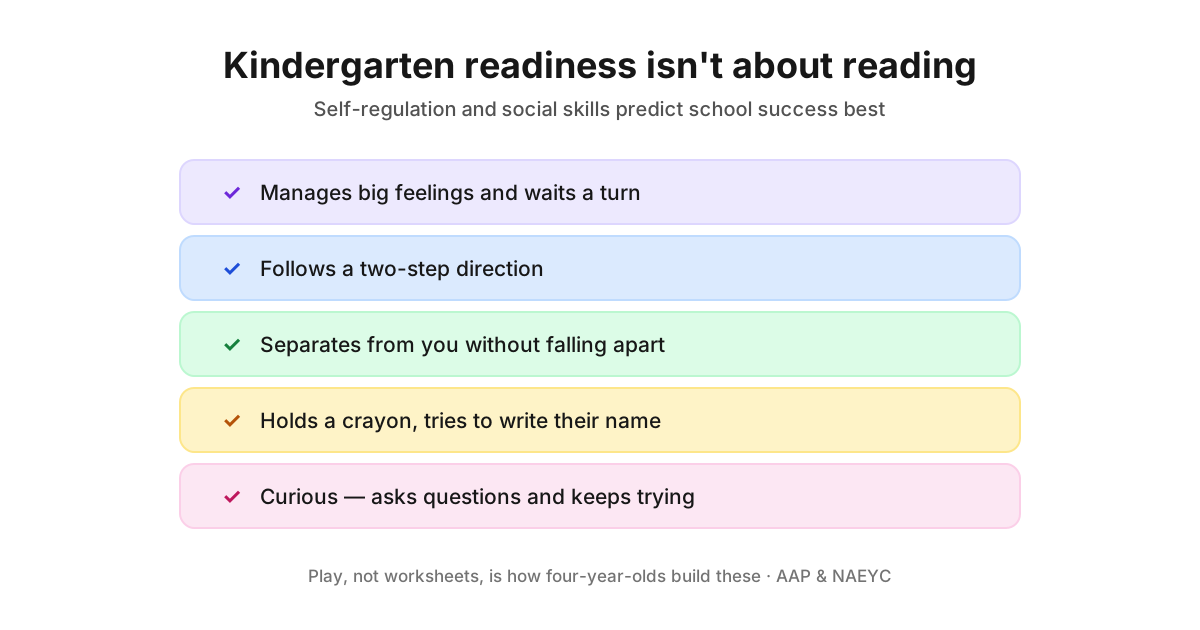
Walk into any store's "school readiness" aisle and you'd conclude kindergarten has an entrance exam: flashcards, phonics workbooks, laminated sight words. Here's the research's plot twist: the skills that best predict how a child does in school aren't academic at all.
The strongest evidence points to self-regulation and social-emotional skills — managing big feelings, following routines, getting along with other kids, persisting when something is hard. The AAP's clinical report on school readiness (School Readiness, Pediatrics) frames readiness around the whole child — physical well-being, social-emotional development, approaches to learning, and language — with academic knowledge as just one strand, not the headline.
Teachers agree, loudly. As NAEYC notes, kindergarten teachers consistently say they'd rather receive a child who can listen, share, and handle frustration than one who can read but can't ride out losing a game. They can teach letters. They can't easily teach a classroom of 22 kids to wait their turn one at a time.
The checklist that actually matters
No single skill is required — kindergartners arrive wonderfully uneven. But these are the areas worth nurturing in the year before school:
Self-regulation (the heavyweight)
- Recovers from disappointment in minutes, not hours — the graduate course of toddler tantrum season
- Follows 2–3 step instructions ("hang up your coat, then come sit on the rug")
- Sits with an activity — a story, a puzzle — for 5–10 minutes
- Waits and takes turns, at least imperfectly
- Handles transitions between activities without falling apart every time
Social skills
- Separates from you without prolonged distress
- Plays cooperatively — shares (sometimes), negotiates roles in pretend play, resolves small conflicts with words more often than fists
- Asks an adult for help when stuck — quietly one of the highest-value school skills
- Shows empathy basics: notices when another child is hurt or sad
Language and communication
- Speaks in full sentences and is understood by unfamiliar adults
- Tells a simple story about something that happened — the long arc that began with the 12–24 month language explosion
- Listens to a book and talks about it — what happened, what might happen next
Independence and self-care
- Uses the toilet independently (daytime), washes hands, manages clothing
- Opens their own lunch containers — ask any kindergarten teacher about this one
- Keeps track of belongings-ish (a coat hook is a skill)
Pre-academics (the garnish, not the meal)
- Counts a handful of objects, knows some letters — especially the ones in their name — recognizes shapes and colors, holds a crayon comfortably. The CDC's 5-year milestones are a good reality check on what's typical: counting to 10, naming some letters when pointed to — not reading chapter books.
Why play is the curriculum
Here's the beautiful irony: the activity that best builds self-regulation looks nothing like school prep. It's play.
The AAP's clinical report The Power of Play lays out the evidence: play — especially pretend play and games with other children — is a primary engine of executive function: working memory, impulse control, flexible thinking. A four-year-old being the "customer" in a pretend restaurant is holding a role in mind, inhibiting out-of-character impulses, negotiating rules, and recovering when the "chef" goes rogue. That's a self-regulation workout no worksheet can match — and the AAP report explicitly warns that displacing play with structured academic drilling for young children can be counterproductive.
The same report notes pediatricians now literally prescribe play. Some evidence-backed "curriculum," all free (AAP):
- Pretend play with peers — the executive-function gold standard
- Board and card games — turn-taking, rule-following, and the crucial skill of losing
- Read-alouds with conversation — comprehension, vocabulary, attention
- Real responsibilities — setting the table, feeding the pet: independence with stakes
- Free outdoor play — risk assessment, negotiation, body confidence
Meanwhile, keep an eye on what competes with play time — the screen-time evidence for preschoolers is mostly a story about displacement.
The year-before-kindergarten game plan
- Practice the school-shaped routines: consistent morning sequence, packing a bag, opening lunch containers, bathroom independence.
- Engineer peer time if your child isn't in preschool or daycare — library story hours, playgrounds, standing playdates.
- Rehearse separation in low-stakes doses: a grandparent afternoon, a drop-off class.
- Narrate feelings and strategies: "You're frustrated the tower fell. Want to take a breath and try a wider base?" — co-regulation graduating into self-regulation.
- Read every single day, and talk about the book like it's gossip.
- Visit the school before day one if you can; familiarity shrinks fear (NAEYC).
If you like checklists that check themselves off gradually instead of inducing panic in August, this is exactly the territory TinyWins covers in its preschool stage — small daily play-and-routine steps that build toward school skills.
Should we wait a year? (the redshirting question)
For summer-birthday kids especially, "redshirting" — delaying kindergarten entry by a year — feels like a safe hedge. The evidence is less enthusiastic than the playground consensus. The AAP's school readiness report notes that delayed entry hasn't shown lasting academic benefits, and that children who would benefit most from school-based services lose a year of access by waiting. Any early advantage from being oldest tends to fade within the first grades.
That's a population-level finding, not a verdict on your child — a kid with identified delays or significant regulation struggles is a genuinely individual call. But the default answer is: send them, and let kindergarten do its job.
If you're worried
Wondering about a delay in language, attention, social skills, or motor development? Don't wait for kindergarten to "see how it goes." Talk to your pediatrician, compare against the CDC's milestone checklists, and ask about a free evaluation through your school district — in the US, districts must evaluate eligible children for preschool special education services at no cost.
The AAP's school readiness guidance emphasizes that identifying and supporting needs before school entry is one of the highest-leverage moves available (Pediatrics). The CDC's "Learn the Signs. Act Early." program explains why watching development and speaking up early matters:
And remember the redshirting debate's quiet resolution: readiness isn't something a child is, it's something families, schools, and communities build. A kid who can lose at Candy Land gracefully, ask the teacher for help, and open their own yogurt is ready for more than kindergarten. The reading will come — it's literally what the building is for.
This article is educational and not medical advice. Always check with your pediatrician/provider.